This post may contain affiliate links, which means we may earn a small commission if you make a purchase through our links, at no extra cost to you. This helps us keep creating great content. Thank you for your support!
Productivity isn't just about willpower; it's about environment. A cluttered desk is a visual to-do list that never ends. Every loose paper, tangled cable, or misplaced pen competes for your brain's processing power.
The "Productive Minimalist" approach isn't about having a stark, empty white desk—it's about "intentional friction." You want to reduce the friction for doing good work (everything within reach) and increase the friction for distractions.
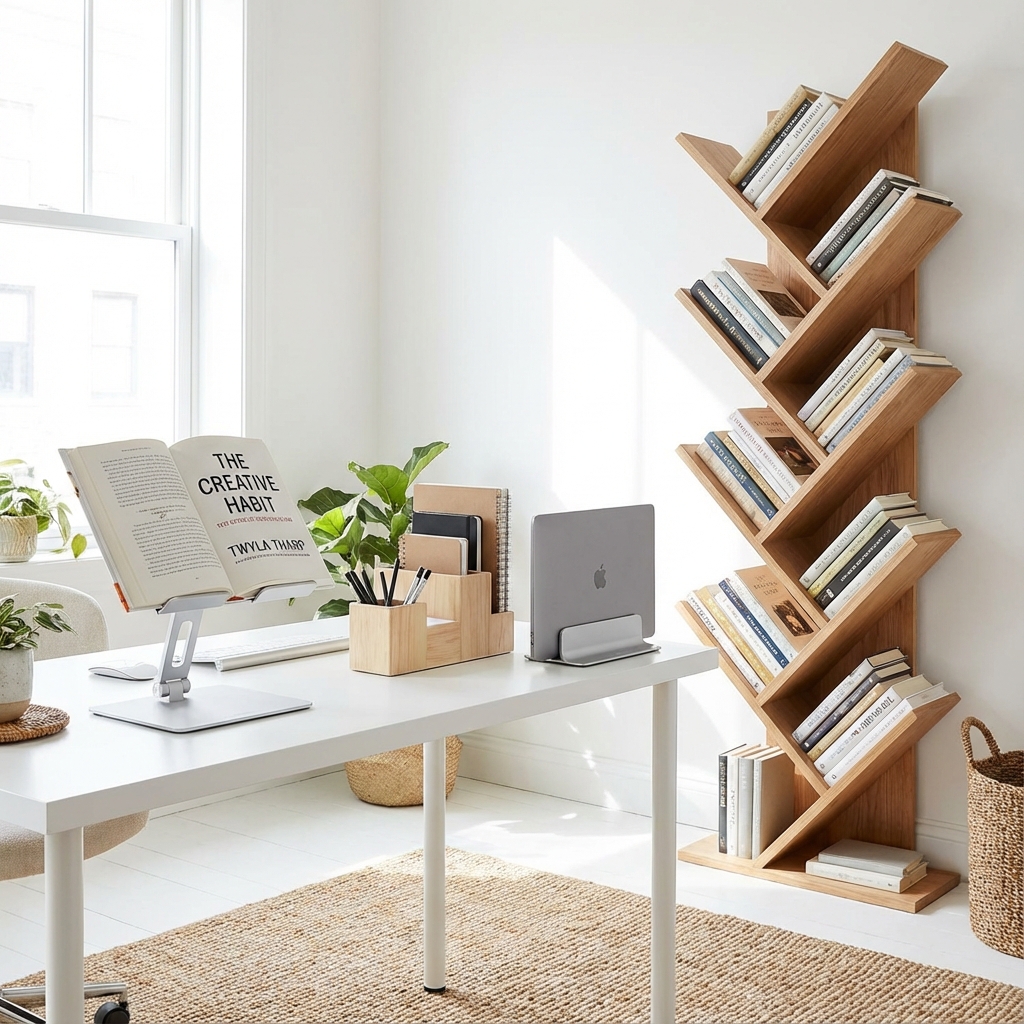
In this deep-dive guide, we break down the exact logic behind our "Shop The Look" office concept. We focus on vertical storage and ergonomic flow to keep your actual work surface clear for deep work.
The Core Concept: "Vertical Clarity"
Most people run out of desk space because they treat their desk 2-dimensionally. They spread out. The secret to a high-performance workspace in a small footprint is to think 3-dimensionally.
By utilizing vertical stands and rotating organizers, we expanded the usable workspace by 40% without buying a bigger desk. Here is the breakdown:
1. The Document Tamer: Rotating Desktop Organizer
Why It Works: The "doom pile" of papers is the enemy of focus. This Rotating Desktop Organizer is a game-changer because it compartmentalizes your clutter.
It allows for "Context Switching." You can keep your finances in one slot, your creative journal in another, and urgent mail in a third. A simple spin switches your brain's context without you having to dig through a stack.
2. The Neck Saver: Vertical Laptop Stand
The Ergonomic Argument: If you use an external monitor (which you should for productivity), your closed laptop often sits flat, taking up a 13x9 inch rectangle of prime real estate.
A Vertical Laptop Stand docks your computer upright in "clamshell mode." This recovers that massive chunk of desk space for your notebook or coffee, and crucially, helps with passive cooling for your machine.
3. The Overflow Valve: Tree Bookshelf
The Strategy: We placed a lightweight Tree Bookshelf right next to the desk. This acts as an "Overflow Valve."
Reference books, manuals, and inspiration binders shouldn't live on your desk. They belong near your desk. This tree shelf holds about 50 books in a footprint smaller than a wastebasket, keeping your visual field clear.
3 Rules for Maintaining a Minimalist Desk
Achieving this look is easy; keeping it is hard. Follow these three rules to maintain the zen:
- Rule 1: The "Touch It Once" Rule. When a piece of mail or a document lands on your desk, deal with it immediately, trash it, or file it in the rotator. Never put it in a temporary pile.
- Rule 2: The End-of-Day Reset. Never leave your desk messy for your future self. Spend the last 3 minutes of your workday returning the pen to the cup, docking the laptop, and straightening the pile. It signals to your brain that the workday is done.
- Rule 3: Cable Invisibility. If you can see a cable, hide it. Visual tangles create subconscious stress. Use simple velcro ties or run cables behind the leg of the desk.
Color Palette Psychology
You'll notice our setup uses White, Light Wood, and Matte Silver.
- White: Reflects light, making the space feel airy and energetic.
- Wood: Adds warmth and texture to prevent the "sterile hospital" feel.
- Silver/Grey: Matches the tech hardware, making devices blend in rather than stand out.